%20(2).png)
Site Drainage Systems & Subsurface Water Management
Subsurface and surface water management is the most critical technical factor in safeguarding structural longevity as well as your property's aesthetics and value. Water is a destructive force when uncontrolled, exerting immense hydrostatic pressure against foundations, destabilizing retaining walls, as well as eroding grades and structures slowly over time (or very suddenly at times!). Our framework calls for complete site consideration before disturbing your property. We analyze entire parcel watersheds, calculate peak runoff volumes, and implement robust, rigid subsurface networks designed to intercept, collect, and discharge water safely away from structural assets.


Local Information
Properties across Litchfield County—including the rugged terrains of Kent, Washington, Roxbury, and Litchfield—are defined by steep topographical shifts, shallow bedrock ledges, and dense, unyielding glacial till soils. These high-silt soils suffer from poor natural percolation, frequently creating perched water tables that trap water near the surface. During seasonal thaws and heavy downpours, water sheets down hillsides and forces its way against foundation walls or underneath hardscape installations. Our drainage layouts in this region rely heavily on deep interceptor curtain drains and native stone swales designed to catch fast-moving sheet flow before it impacts the active living areas of the property.
The rolling landscapes and expansive residential properties of Upper Fairfield County— like Ridgefield, Newtown, and Easton—feature complex grading variations and extensive structural footprints. Large roof areas, expansive driveways, and multi-tier terraced hardscapes generate immense concentrated runoff during storm events. Our localized drainage layouts integrate these artificial impervious surfaces into high-capacity water management networks. We calculate the exact hydraulic demand of roof conductors and surface catchments, routing the water through continuous, smooth-walled conduits to hidden on-site detention systems or planned rain gardens that protect down-gradient land stability. More dense residential areas like Westport and Fairfield deal with more lot restrictions and smaller lot sizes, leading to more system design work being necessary to ensure effectiveness and local compliance.
In the lower-lying plains and river valley sectors of Hartford County, such as Farmington, Collinsville, Avon, and Simsbury, properties regularly contend with a completely different hydrological profile: heavy river-valley silts and dense, impermeable clay layers. These soil profiles retain water for extended periods, leading to high water tables and chronic pooling in low-elevation turf and outdoor living spaces. Our water management strategies here focus on extensive sub-surface grid drainage, multi-tier French drain installations, and deep collection basins equipped with gravity-discharge outlets or mechanical lift stations to force water out of low-percolation zones.
Along the highly sensitive Connecticut coastline—stretching from Greenwich and Westport to Old Saybrook and Stonington—drainage systems must handle high water tables, brackish groundwater fluctuations, and tidal backup risks. Properties built along these shorelines are subjected to severe storm surges and coastal weather patterns that quickly overwhelm standard gravity-fed systems. Our shoreline water management protocol utilizes specialized backflow prevention check-valves, heavy-duty commercial sump configurations, and wide-footprint infiltration galleries that allow stormwater to disperse into sandy coastal subgrades without violating strict Coastal Area Management (CAM) regulations.
Effective water management layouts require precise mathematical and topographical mapping rather than guesswork. Our process utilizes precision LiDAR data and physical site elevations to establish an absolute map of your property's watershed. We calculate the exact runoff coefficients of every square foot of your land, whether it is turf, woodland, or concrete. This data allows us to size subsurface pipes, collection basins, and retention chambers to handle 50-year and 100-year storm frequencies. Every system is planned with built-in redundancies, cleanout ports, and smooth transitions to ensure the infrastructure operates reliably under peak hydraulic load.
General Design Information
Effective water management layouts require precise mathematical and topographical mapping rather than guesswork. Our process utilizes precision LiDAR data and physical site elevations to establish an absolute map of your property's watershed. We calculate the exact runoff coefficients of every square foot of your land, whether it is turf, woodland, or concrete. This data allows us to size subsurface pipes, collection basins, and retention chambers to handle 50-year and 100-year storm frequencies. Every system is planned with built-in redundancies, cleanout ports, and smooth transitions to ensure the infrastructure operates reliably under peak hydraulic load.
Popular Material Selections & Finishes
The survival of a drainage system depends entirely on the physical durability of the hidden materials buried beneath the surface. We reject retail-grade components in favor of heavy-wall industrial materials.

Learn About How We Approach the Site Drainage Systems & Subsurface Water Management Design Process
Our water management execution is handled across four highly disciplined phases: Evaluation & Mapping:
We perform a complete physical site analysis, identifying water entry vectors, mapping property elevations, and calculating peak runoff metrics based on localized watershed data. If we need to consult with local municipalities, any HOA or neighboring properties, we handle the project feasibility analysis now also.
Precision Excavation & Subgrade Pitching: Trenches are cut to exact structural depths, ensuring a continuous, unbroken down-gradient pitch. We install heavy structural filter fabrics to isolate the excavation zone from native soil silts.
Assembly & Aggregate Bedding: Rigid, smooth-walled PVC drainage pipes are mechanically glued and laid at a strict pitch. We backfill the entire core with clean, washed ¾-inch crushed aggregate before sealing the filter envelope. Discharge Testing & Site Restoration: The system is routed to its planned discharge terminal—whether a drywell gallery, a stone-lined daylight apron, or an infiltration field. The surface is then seamlessly restored with premium turf, plantings, or masonry finishes.
The Structure and Site
Subsurface drainage operates on the laws of physics and gravity. Every component must be structurally protected from the surrounding soil to prevent long-term functional failure.
Complete drainage systems managing high water volumes can become very complicated: requiring multiple kinds of water collection, movement, detention and dispersion mechanisms as well as redundancies.
How the drainage piping itself is installed and protected is similar across installs, so we will use the common residential drainage components of Curtain Drains and French Drains to illustrate how the piping is often installed and protected across many kinds of systems.
A true French drain or curtain drain is a multi-layered structure of materials. The trench must be lined with heavy, non-woven geotextile filter fabric (minimum 4oz to 6oz burst strength) to act as a permanent barrier between the native soil and the drainage core while still remaining permeable. The perforated rigid PVC pipe is laid at the absolute bottom of the trench, holes facing down to capture groundwater as it rises. For areas managing high amounts of water, more piping or larger diameter pipe is used. The trench is then backfilled with clean, thoroughly washed ¾-inch crushed aggregate, completely surrounding the pipe. The filter fabric is then wrapped over the top of the stone bed with a generous overlap, creating an enclosed filter envelope that allows water to pass instantly while completely blocking fine sand and silt migration. Solid piping, near-surface piping, or weaker piping may use a sand layer as well for extra protection
Access, area and grade are the first site factors to consider when planning a drainage project. This dictates how the rest of the project plan will fall in line. As for the install itself: Trenching to depth can disrupt established root zones, cross utility lines, reveal in ground boulders blocking our path, or temporarily weaken adjacent subgrades or structures. These "site factors" are what make your project unique, and each must be considered for a successful project.
The "location of best fit" is determined to ensure ample access and space, as well as to mitigate encounters with root systems, existing structures, and rocky soild as is possible. Once we're working, we utilize specialized tracking machinery that distributes weight evenly to prevent soil compaction across your property. Trenches are excavated to strict slopes (minimum 1-2% continuous pitch). Soil profiles are evaluated in real-time; if high-silt, boulders or expansive clays are encountered, we over-excavate or modify the layout of the trenches to replace the native material with specialized aggregates that accelerate water migration into the system.
Regulatory Considerations for Site Drainage Systems & Subsurface Water Management
Managing site water runoff in Connecticut involves strict municipal building codes, Inland Wetlands and Watercourses Agency (IWWA) regulations, and local environmental ordinances. Properties cannot legally discharge concentrated stormwater directly onto neighboring parcels or public rights-of-way. We manage the entire regulatory and compliance pathway for you. We plan mitigation frameworks—such as subsurface drywells, galleys, and planned infiltration fields—that slowly recharge stormwater back into the aquifer on your own property, ensuring complete code compliance and securing rapid municipal permit approvals.
Some of Our Project Portfolio


Get in Touch!
Additional Features & Related Services
High-Capacity Subsurface French Drains: Intercepting rising groundwater and relieving hydrostatic pressure along foundations and structural subgrades.
Interceptor Hillside Curtain Drains: Capturing surface runoff and shallow sheet flow across sloped landscapes before it reaches active property features.
Rigid Foundation Footing Drains: Providing critical perimeter water management utilizing heavy-wall, smooth conduits to safeguard foundational stability.
Roof Downspout Conductor Routing: Diverting high-volume roof runoff entirely away from structural bases via continuous, underground solid-pipe connections.
Heavy-Duty Footing Waterproofing: Applying high-performance barrier membranes to subsurface walls to permanently block moisture migration into the property.
Topographical Swale & Rain Garden Construction: Sculpting natural surface contours and high-absorption planting zones to cleanly collect, slow down, and disperse overland water flow.
Subsurface Drywell & Cultec Infiltration Galleries: Installing high-capacity underground containment grids for controlled, safe on-site stormwater retention and aquifer recharging.
Channel & Trench Drain Masonry Integration: Seamlessly embedding architectural drainage tracks within premium patios, driveways, and entry courts to eliminate surface pooling.
Common Installation Failures to Avoid
Substandard Corrugated Piping: Utilizing cheap, black corrugated pipe wrapped in thin, sock-like fabric filters. The high internal friction of corrugated walls slows water velocity, allowing fine silts to settle, accumulate, and inevitably block the pipeline.
Structural Trench Collapse: Under minimal soil pressure or localized vehicular weight, flexible corrugated pipe easily crushes and collapses, completely severing the subsurface drainage line.
Native Dirt Backfilling & Fabric Blinding: Backfilling drainage trenches with excavated native dirt or unwashed bank-run gravel. This native silt rapidly migrates into the stone bed, binding the fabric envelope and sealing the system in stone—a structural failure known as "blinding" that blocks water entry and triggers immediate surface flooding.
Cross-Connecting Roof & Footing Lines: Running high-volume roof downspouts into the exact same perforated pipe dedicated to foundation footing drains. During heavy downpours, this structural oversight actively forces thousands of gallons of roof runoff directly against the property's foundation.
Deficient Gravity Pitching: Installing drainage pipelines without calculating a continuous down-gradient gravity pitch. This layout failure creates stagnant water zones inside the pipe that rapidly breed destructive root intrusions and collect heavy debris clogs.
Site Drainage Systems & Subsurface Water Management FAQ's
What is the difference between a French drain and a curtain drain?
The difference lies in their placement and specific operational intent. A French drain is installed deep along a foundation footing or structural wall to intercept rising groundwater and relieve hydrostatic pressure before moisture pushes into the lower levels of a property. A curtain drain is a shallow interceptor trench built uphill or across a lawn slope to catch surface water and shallow sheet flow as it travels down a grade, redirecting it completely around your active outdoor living spaces or structures.
Why should I avoid using flexible black corrugated pipe for my drainage system?
Flexible corrugated pipe is built for cheap, temporary utility, not long-term structural reliability. The ridges on the inside of corrugated pipe create heavy friction, slowing water down and encouraging dirt, silt, and organic matter to settle and form stubborn clogs. Over time, tree roots easily puncture thin corrugated walls, and the pipe lacks the structural strength to resist soil shifts, causing it to crush flat under minimal overhead weight. We use only rigid Schedule 40 or SDR-35 PVC, which has a perfectly smooth interior and exceptional crush resistance.
Will a subsurface drainage system ruin the look or layout of my yard?
Not at all. When planned and executed correctly, a professional drainage system is entirely invisible. The functional pipelines, gravel beds, and collection structures are completely buried deep underground. The surface is backfilled with rich topsoil and restored seamlessly with premium turf, plantings, or masonry. The only visible components are clean, low-profile catch basin grates or pop-up emitters that blend perfectly into the hardscape layout or lawn transitions.
Where does the water go once it enters the subsurface drainage network?
In Connecticut, stormwater cannot be legally dumped onto neighboring properties or public roads. Therefore, your drainage network must route water to a planned on-site discharge point. Depending on your property's soil structure and topography, this is achieved by gravity-feeding the water into a daylight discharge on a stable rock apron, directing it into an open native rock swale, or routing it into an underground retention gallery—such as concrete drywells or modular Cultec plastic chambers—where the water can slowly filter back into the subgrade safely.
Other Spaces We Build and Services We Provide
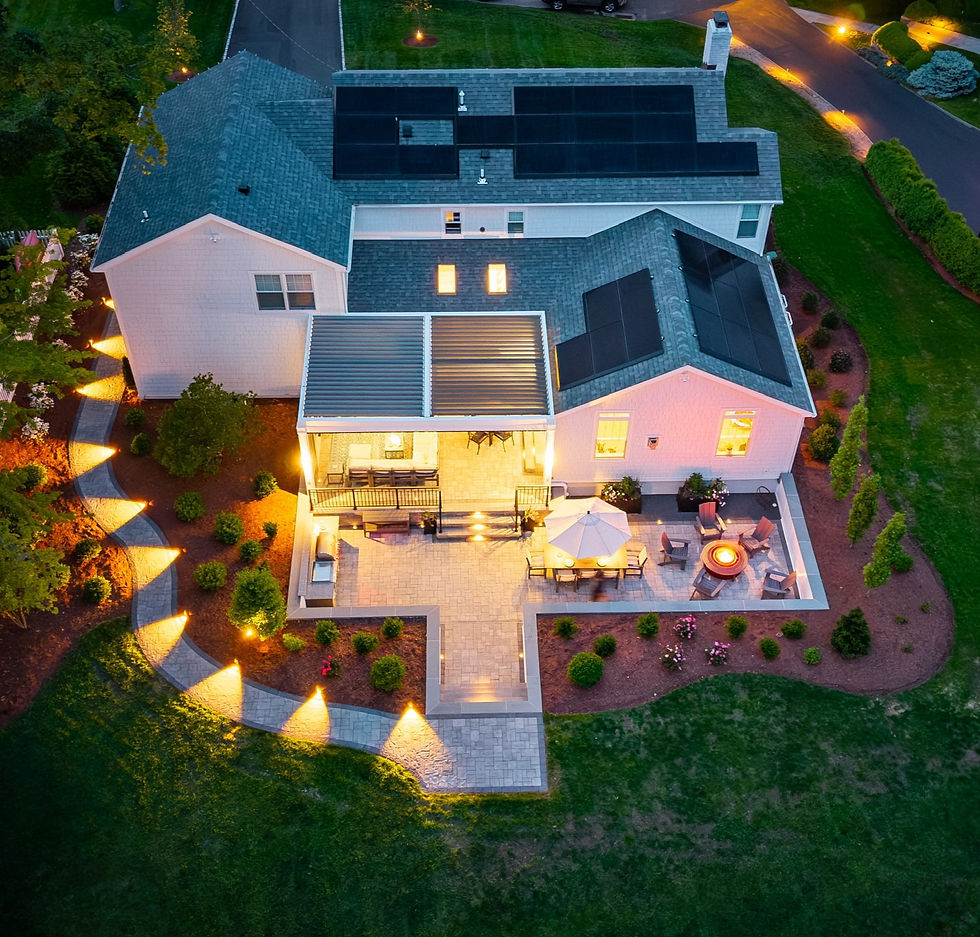
Exterior and Landscape Lighting

Fireplaces and Fire Features

Water Features and Waterfalls

Stone Veneer and Composite Stone Veneer

Patios and Walkways

Outdoor Kitchens

Concrete

Deck Construction

Trails and Garden Paths

Driveways

Retaining Walls

3-Season and Enclosed Outdoor Living Spaces
Softscape Design & Planting Installation
Outdoor Living Design and Build

Double-Sided Stone Walls and Stone Columns

Fencing and Privacy Plantings
Commercial Retaining Walls-- ADD INTO RETAINING WALL SECTION


