%20(2).png)
Property Fencing & Privacy Tree Installations
Establishing privacy along your property lines requires a practical look at your layout, your soil, and your local zoning rules. Homeowners looking to screen out roads, neighbors, or unwanted views generally choose between two distinct methods: structural fencing or living privacy plantings. A fence offers an immediate visual barrier with a narrow physical footprint, making it ideal for tight spaces or quick containment. Privacy plantings take longer to mature but offer superior sound absorption, soften property borders, and can grow far past the height limits imposed on fences. While these installations function perfectly as independent projects, combining them provides the ultimate layout—the fence delivers immediate privacy at ground level, while a staggered line of evergreens grows over the top to provide permanent, high-level screening.


Local Information
Properties across Litchfield County—including Kent, Washington, Roxbury, and Bethlehem—frequently feature large acreage, rolling hills, and heavy populations of local wildlife.
For Fencing: The ground in this region is notorious for dense glacial till and hidden stone ledges. Installing a straight fence line requires mechanical augers capable of clearing rock, and posts must be set deep to handle the high wind loads found on open ridges and hillsides. Clear-grade Western Red Cedar post-and-rail or privacy panels are favored to match the rural landscape.
For Privacy Plantings: High deer pressure makes traditional choices like standard arborvitae highly risky. Planting layouts in Litchfield County focus on rugged, deer-resistant native evergreens like Norway Spruce or Canadian Hemlock that can establish deep root systems in rocky soils without being destroyed by local foraging.
The expansive residential properties and rolling pasture transitions of Upper Fairfield County—anchored by Ridgefield, Newtown, and Easton—demand boundary solutions that can scale across long distances without looking institutional.
For Fencing: Securing multiple acres requires robust, cost-effective options. Homeowners frequently utilize clear-cedar post-and-rail fencing backed with heavy-duty, vinyl-coated steel mesh. This keeps pets and wildlife contained while preserving the open, long-range views of the property.
For Privacy Plantings: To block out distant neighboring structures or large outbuildings on expansive lots, single rows of trees are insufficient. Layouts focus on deep, multi-tiered evergreen backdrops using large-scale species like White Pine and Norway Spruce to create a natural, park-like border.
In suburban neighborhoods throughout Hartford County, such as Avon, Simsbury, and Farmington, homes sit closer together, and managing traffic noise from local roads is a frequent priority. The soil here often consists of dense clays and fine silts that hold water for extended periods.
For Fencing: Property lines require absolute geometric precision to look right against manicured lawns. Tongue-and-groove cedar privacy panels or clean, dark aluminum fences are meticulously leveled to match the exact grade of the property.
For Privacy Plantings: Heavy clay soils trap moisture, which can easily drown plant roots if left unmanaged. Planting layouts here require checking soil saturation, minor bed elevations to improve water movement, and utilizing dense evergreen options like Green Giant Arborvitae or Skip Laurel to absorb street-front noise.
Shoreline properties along the Connecticut coast—stretching from Greenwich and Westport to Old Saybrook and Stonington—deal with low-nutrient sandy soils, high tidal water tables, and relentless salt air.
For Fencing: Standard softwoods and cheap hardware will rust, warp, and split within a few seasons. Shoreline layouts require heavy-gauge, powder-coated structural aluminum or ultra-dense hardwoods like Ipe, fastened exclusively with marine-grade stainless steel screws to withstand coastal gales.
For Privacy Plantings: Constant wind and salt spray physically scorch vulnerable evergreen needles. Living screens are strictly limited to salt-hardy, wind-tolerant species such as Japanese Black Pine or Eastern Red Cedar that can establish stable root systems in loose, sandy coastal soils.
The long-term success of a privacy layout comes down to clear calculations regarding wind, space, and property lines.
Fencing Layout Mechanics: A solid 6-foot privacy fence behaves like a massive sail in a storm. Post sizing, spacing intervals (typically kept at 6 to 8 feet), and footing depths must be calculated to prevent the fence from leaning over time. We also verify your exact property pins to ensure the installation sits legally within your borders.
Privacy Planting Layout Mechanics: Planning tree lines requires mapping out the mature canopy spread and root radius of the species. Trees must be spaced to allow adequate sunlight and air circulation between them, which prevents the lower branches from dying off.
Combined Installations: When utilizing both options together, we maintain a strict 5-to-8-foot offset between the physical fence posts and the tree root balls. This guarantees that as the trees mature, their roots will not lift the concrete fence footings or warp the panels.
General Design Information
The long-term success of a privacy layout comes down to clear calculations regarding wind, space, and property lines.
Fencing Layout Mechanics: A solid 6-foot privacy fence behaves like a massive sail in a storm. Post sizing, spacing intervals (typically kept at 6 to 8 feet), and footing depths must be calculated to prevent the fence from leaning over time. We also verify your exact property pins to ensure the installation sits legally within your borders.
Privacy Planting Layout Mechanics: Planning tree lines requires mapping out the mature canopy spread and root radius of the species. Trees must be spaced to allow adequate sunlight and air circulation between them, which prevents the lower branches from dying off.
Combined Installations: When utilizing both options together, we maintain a strict 5-to-8-foot offset between the physical fence posts and the tree root balls. This guarantees that as the trees mature, their roots will not lift the concrete fence footings or warp the panels.
Popular Material Selections & Finishes
Fencing Material Grades: We select clear-grade Western Red Cedar, which contains natural oils that resist rot and boring insects, or commercial-grade aluminum with UV-hardened powder coatings. We reject thin, retail-grade wood panels that warp and split after a single winter.
Planting Specimen Selections: We hand-select only northern-grown, cold-acclimated, balled-and-burlapped (B&B) evergreens from trusted wholesale nurseries. Every tree is inspected for uniform branching down to the ground, a strong central leader, and a solid, intact root crown to ensure immediate privacy and high survival rates.


Learn About How We Approach the Property Fencing & Privacy Tree Installations Design Process
Sightline Mapping & Utility Checks: We measure property setbacks, track visual lines of sight from your active outdoor zones toward neighboring structures, check utility pathways, and map exact plant-spacing intervals.
Subsurface Anchoring & Bed Excavation: Fence posts are augered past the frost line and anchored into place. Concurrently, wide, saucer-shaped planting beds are cut and optimized with performance aggregates.
Fence Assembly & Specimen Planting: Fence panels are assembled with strict horizontal alignment. Specimen evergreens are set at proper structural grades with exposed root flares, utilizing staggered spacing.
Irrigation Adjustment & Final Mulching: Water runs are checked to support the new trees, beds are dressed with clean organic mulch to regulate root temperatures, and the entire workspace is fully cleaned and detailed.
The Structure and Site
Both physical fences and living tree lines depend on deep structural foundations to stay straight and healthy through New England winters.
Fencing Building Standards: Every primary fence post must be sunk to a depth of 36 to 48 inches. Posts are anchored using high-strength concrete or thoroughly compacted aggregate collars. Crucially, the post must sit on top of a gravel base layer rather than being entirely enclosed in a flat concrete pool; this allows groundwater to drain away from the bottom of the wood and prevents underground rot.
Planting Installation Standards: Specimen trees must be set into wide, shallow, saucer-shaped holes that encourage rapid lateral root growth. The top of the root flare must sit exactly level with or slightly above the finished yard grade. All wire cages, synthetic twine, and heavy burlap are removed from the upper third of the root ball to allow roots to branch out cleanly into the surrounding soil.
Working directly along property lines requires careful field execution to protect your lawn and avoid costly disputes. Digging post holes or large tree pits carries a constant risk of crossing shallow utility lines or property boundaries. For fencing, we run tight parallel string-lines and use laser levels to ensure the posts are perfectly plumb. For tree installations, moving specimens that weigh hundreds of pounds requires utilizing wide-track, low-impact machinery to distribute weight evenly and prevent deep ruts in your lawn. If poor fill or compacted clay is discovered during digging, the planting beds are over-excavated and amended with organic material to give the roots an optimal start.
Regulatory Considerations for Property Fencing & Privacy Tree Installations
Navigating local codes in Connecticut requires a clear understanding of the difference between structural restrictions and landscaping rules.
Fencing Restrictions: Almost every municipality enforces strict height caps on permanent structures. Standard residential zoning limits side and rear privacy fences to a maximum height of 6 feet, and front yard boundaries to 4 feet.
Privacy Planting Restrictions: Living plant barriers are generally exempt from municipal height limits. This means a property owner can legally install a line of 12-to-15-foot evergreens to block a neighbor's second-story view or windows where a structural fence would be legally rejected by the town.
Some of Our Project Portfolio


Get in Touch!
Additional Features & Related Services
Architectural Western Red Cedar Fencing: Custom building of privacy and boundary partitions using select, clear-grade cedar lumber.
Thick-Gauge Powder-Coated Aluminum Fencing: Installation of durable, rust-resistant metal boundary systems designed for long-term property containment.
Staggered Two-Row Living Privacy Screens: Strategic planning and planting of offset evergreen matrices to form high-density, natural visual barriers.
Acoustic Border Noise Mitigation: Combining dense wood fence panels with thick evergreen layering to intercept and dampen road or neighbor noise.
Deer-Resistant Specimen Tree Planting: Sourcing and installing hardy varieties like Norway Spruce, Hemlock, and Holly that resist heavy wildlife foraging.
Deep-Hole Augering & Concrete Post Anchoring: Executing mechanical drilling past the 42-inch frost depth to construct stable, permanent fence footings.
Root-Flare Optimized Tree Installation: Precise biological tree setting techniques to guarantee high survival rates and rapid root establishment.
Subsurface Plant Bed Clay Remediation: Over-excavating wet, high-retention clay profiles along borders and replacing them with porous aggregates to protect tree roots.
Common Installation Failures to Avoid
Shallow Fence Post Depth: Sinking fence posts only 24 inches into the ground or backfilling them with loose native dirt. Over a few seasons of heavy wind and winter frost-heaves, the posts loosen, causing the entire fence line to sag and buckle.
Trapping Water inside Concrete Post Footings: Pouring concrete entirely around the bottom of a wood post without a gravel drainage pocket at the base. This traps groundwater directly against the cut end of the wood, causing the post to rot underground and snap off at ground level within 5 to 7 years.
Jammed Single-Line Tree Walls: Planting privacy trees in a tight, compressed single-file line right against each other to get an instant screen. As the canopies grow, the inner branches are completely starved of light and air, causing the lower needles to drop, breeding fungal diseases, and leading to widespread die-off.
Burying the Root Flare: Placing privacy trees too deep in the planting hole and piling heavy soil and decorative mulch up against the trunk. This suffocates the root system, traps moisture against the bark, causes trunk rot, and triggers a slow decline and eventual death of the tree within 3 years.
Property Fencing & Privacy Tree Installations FAQ's
What is the benefit of a staggered two-row planting layout over a straight single line of trees?
A straight single line forces adjacent trees to compete directly for the exact same pocket of sunlight, groundwater, and air circulation. As they grow, their inner branches choke each other out, leading to bare spots and needle drop. A staggered two-row layout (arranged in an offset zigzag pattern) gives each individual tree ample breathing room and maximum light exposure to grow dense and full from top to bottom, while providing a much thicker, multi-dimensional visual and acoustic barrier for the property.
Why does local zoning allow tall trees along a property line but limits fence heights to 6 feet?
Local municipal zoning codes place strict limits on permanent backyard structures like fences to maintain neighborhood density rules and prevent visual crowding. However, trees and living landscapes are categorized as natural vegetation rather than permanent structures. Because they are dynamic and open, they are generally completely exempt from these height caps, allowing property owners to legally use tall evergreens to block high sightlines that a fence cannot legally reach.
How do you prevent a wood fence from warping or rotting over time in Connecticut weather?
Fence failure comes down to wood selection and installation mechanics. We use clear-grade Western Red Cedar, which naturally resists moisture and insect damage far better than standard pressure-treated pine. Additionally, we set posts with a gravel drainage pocket underneath the concrete collar. This prevents groundwater from pooling at the base of the wood, completely eliminating the subterranean rot that causes standard fences to lean and snap.
What should I do if my privacy trees look healthy but start turning thin and brown on the inside?
Interior browning is typically a sign of light and air starvation, common when trees are planted too close together or have grown into a tight single wall. Evergreens naturally shed inner needles that no longer receive sunlight. However, if the browning is aggressive, it can indicate a drainage issue, such as standing water rotting the roots, or a common fungal condition caused by poor air circulation. Ensuring proper spacing and keeping downspout water away from the beds is vital to reversing this decline.
Other Spaces We Build and Services We Provide
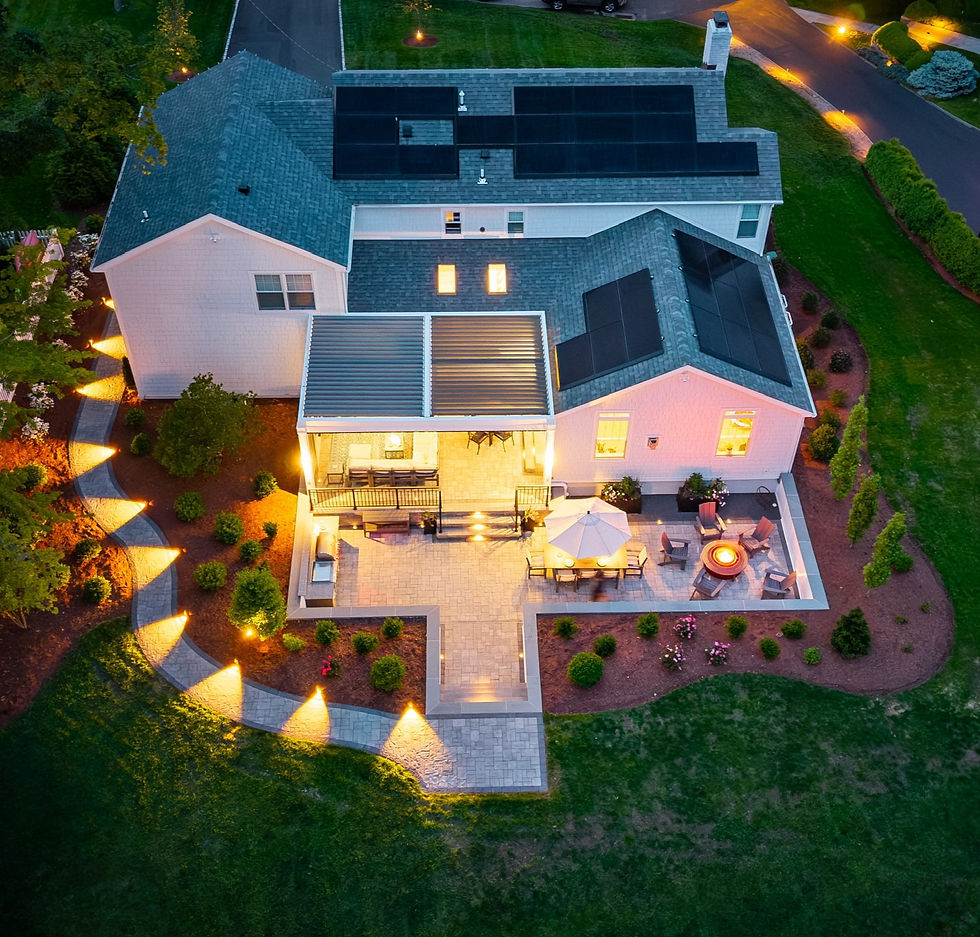
Exterior and Landscape Lighting

Fireplaces and Fire Features

Water Features and Waterfalls

Stone Veneer and Composite Stone Veneer

Patios and Walkways

Outdoor Kitchens

Concrete

Deck Construction

Trails and Garden Paths

Driveways

Retaining Walls

3-Season and Enclosed Outdoor Living Spaces

Site Drainage & Water Management
Softscape Design & Planting Installation
Outdoor Living Design and Build

Double-Sided Stone Walls and Stone Columns
Commercial Retaining Walls-- ADD INTO RETAINING WALL SECTION


