%20(2).png)
Custom Stone Patios & Premium Walkways
We approach hardscaping as a structural discipline first and an aesthetic one second. Our design-build methodology ensures that every patio and walkway is an enduring and permanent addition to the property as well as your lifestyle. We offer a full spectrum of flatwork masonry services, from traditional dry-laid natural stone to modern, precision-engineered interlocking systems from Unilock and Techo-Bloc. Our focus is on mitigating the environmental stressors of the Northeast through over-built bases and sophisticated site-water management.


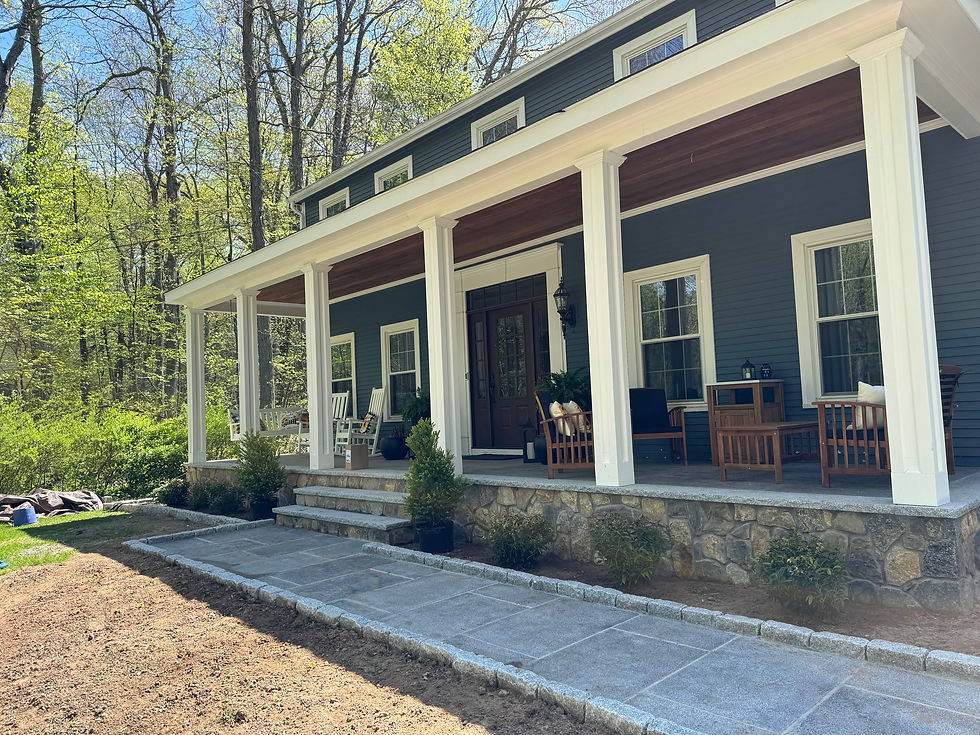
Local Information
In the Litchfield Hills, hardscape design is often dictated by the rugged, rocky topography. Properties in areas like Litchfield, Goshen, and Washington frequently contend with significant glacial till and subterranean ledge rock. This becomes more of an issue for features requiring a permanent foundation (42in+ deep) like Fireplaces. For projects in Woodbury and Roxbury, we specialize in managing steep grade changes through tiered masonry and reinforced structural landings. In areas like Bethlehem and Watertown, where elevation increases the intensity of the freeze-thaw cycle, our installations prioritize deep-set frost protection to prevent the vertical shifting common in native-soil foundations.
The Fairfield County region requires a sophisticated balance between lifestyle and aesthetic needs with strict environmental stewardship. We navigate the complex Impervious Surface Ratios (ISR), elevation changes, zoning restrictions and wetlands regulations prevalent in towns like Newtown, Ridgefield, Redding, Wilton, or Sherman. In Fairfield County lakeside communities like New Fairfield and Brookfield, our designs often incorporate permeable infrastructure and a natural aesthetic to satisfy local conservation commissions, and potentially property associations. For high-end, suburban-residential projects in areas like New Canaan, we emphasize architectural cohesion. nsuring your new hardscaping fits perfectly on your property while still packing the aesthetic "punch" and lifestyle improvement you're looking for.
Hartford County presents unique challenges due to the "Red Clay" and heavy silt deposits found throughout the Connecticut River Valley. In Avon, Simsbury, and Farmington, soil stability is the primary concern; these non-porous soils hold moisture, leading to significant hydrostatic pressure. In turn this cracks concrete and causes heaving in pavers. We remedy this by over-excavating and installing deeper, free draining bases. Our builds in more dense areas like West Hartford and Glastonbury utilize advanced drainage systems to manage water on tight lots. For estates in Burlington and Canton, we focus on integrated drainage solutions that move water rapidly away from the hardscape footprint to prevent the saturation of these clay-heavy subsoils.
The Connecticut shoreline demands an structural focus on salt-air resilience and tidal impact. Serving the "Gold Coast" communities of Fairfield, Greenwich, Westport, and Darien, we utilize high-density materials that resist salt-pitting and mineral degradation while still allowing for the permeability often needed. In towns like New Canaan and Southport, our hardscaping is designed with architectural cohesion in mind, and to withstand the humidity and temperature fluctuations of a near-maritime climate. For coastal properties in areas Madison, Stonington, Old Lyme, Guilford, and Branford, we work within DEEP (Department of Energy and Environmental Protection) coastal setbacks, and manage the planning complexity, ensuring that all patio runoff is managed onsite to protect the Long Island Sound watershed. Properties near this area, in Stonington / Mystic for example, also commonly have confusing jurisdiction and historic district influence. We serve as your principal point of contact to give you a simple and stress free pre-construction and planning experience.
While we can create stunning masonry compositions, our focus when designing and installing patios or walkways is on the site and surrounding enviroment, not just aesthetics or finishes. Most hardscapes, patios and walkways fail from:
Drainage Issues: Water cannot escape the area fast enough, causing damage over time, especially during winter time where the ground is continually freezing and thawing to different degrees.
Improper Base Prep: Different areas have different soil composition- each with their own level of stability, permeability and surrounding grade considerations. Your patio or walkway base must reflect these site factors. It is not just a hard surface to lay stone on, it is a crucial barrier between your new hardscape installation and the elements that can damage it over time.
While bad drainage and poor base composition cause the install itself to fail, elevation changes are the #1 cause of disapointment and confusion for property owners getting a hardscape done, or many other types of projects for that matter.
Not considering elevation appropriately leads to unexpected mid-project additions, changes, and finish discrepancies from what was promised. But unfortunately, in the rushed construction quoting enviroment of today, hardscape contractors regularly do not account for elevation and site factors from the start, leading to that lack of clarity and unexpected surprises when work starts.
We bring up these considerations right from the start, and ensure our pricing reflects a complete installation from the start, not a best case scenario or minimalist quote.
General Design Information
While we can create stunning masonry compositions, our focus when designing and installing patios or walkways is on the site and surrounding enviroment, not just aesthetics or finishes. Most hardscapes, patios and walkways fail from:
Drainage Issues: Water cannot escape the area fast enough, causing damage over time, especially during winter time where the ground is continually freezing and thawing to different degrees.
Improper Base Prep: Different areas have different soil composition- each with their own level of stability, permeability and surrounding grade considerations. Your patio or walkway base must reflect these site factors. It is not just a hard surface to lay stone on, it is a crucial barrier between your new hardscape installation and the elements that can damage it over time.
While bad drainage and poor base composition cause the install itself to fail, elevation changes are the #1 cause of disapointment and confusion for property owners getting a hardscape done, or many other types of projects for that matter.
Not considering elevation appropriately leads to unexpected mid-project additions, changes, and finish discrepancies from what was promised. But unfortunately, in the rushed construction quoting enviroment of today, hardscape contractors regularly do not account for elevation and site factors from the start, leading to that lack of clarity and unexpected surprises when work starts.
We bring up these considerations right from the start, and ensure our pricing reflects a complete installation from the start, not a best case scenario or minimalist quote.
Popular Material Selections & Finishes
The "finish" is the visible layer of your project, but its selection is based on much more than just color. We guide clients through a spectrum of materials, each offering different thermal properties, enviornmental implications, slip resistance, potential applications, and maintenance requirements.


Landscape Lighting
Popular Materials: Solid Cast Brass, Heavy-Gauge Raw Copper, Aircraft-Grade Anodized Aluminum, Low-Voltage Integrated LED Modules (2700K–3000K), Multi-Tap Transformers (12V–15V).
Common Applications & Technical Info: Engineered for structural facade highlighting, safe pathway illumination, security boundary mapping, and hardscape accentuation (including under-cap wall lights and flush step inserts). Systems operate on low-voltage (12V–15V) alternating current routed through direct-burial landscape wiring (typically 12/2 or 10/2 AWG). Precision voltage drop calculations are mandatory for long runs to prevent dimming or uneven lumen output at the end of a zone line. To withstand high soil acidity, heavy New England rainfall, and seasonal freeze-thaw cycles, all subterranean wire joints must utilize moisture-proof, silicone-filled mechanical splices or heat-shrink tubing to stop ground faults and capillary water wicking into the copper leads.
Aesthetics & Maintenance: Focuses on seamless visual design utilizing specific color temperatures: 2700K warm-white is preferred to enhance the rich earth tones of natural New England masonry and foliage, while 3000K provides a crisper look for contemporary architectures or silver-toned stone flatwork. Heavy cast brass and copper alloys are specified because they naturally oxidize into a deep structural bronze or verdigris patina, completely eliminating the chipping, bubbling, and corrosion issues common to painted metals. Maintenance requires seasonal pruning of surrounding plant growth, clearing mulch off lens housings to maintain proper thermal dispersion, and checking fixture alignments after winter frost heaving.
Pricing Guidance: Professional-grade solid cast brass and copper low-voltage LED systems represent a premium architectural investment. They deliver an indefinite operational lifespan and a fractional energy footprint, easily outperforming cheap aluminum or retail-grade composite alternatives.
Porcelain (flatwork)
Popular Materials: 2cm (20mm) Structural Architectural Porcelain Pavers, Large-Format Porcelain Slabs, Textured Anti-Slip Pool Deck Slabs.
Common Applications & Technical Info: Premium horizontal surfacing designed for high-end contemporary patios, luxury pool surrounds, primary pedestrian walkways, and elevated structural pedestal terraces. Kiln-fired at extreme temperatures exceeding 2,200°F, the clay body completely vitrifies to achieve a near-zero water absorption rate (less than 0.05% per ASTM C373 testing criteria). This technical rating renders the material entirely frost-proof and immune to the thermal shock, scaling, and micro-fissuring common in standard pavements during Connecticut winters. Dry-lay installations require an ultra-precise, open-graded aggregate base assembly (clean 1/4-inch stone chipping bed over a highly compacted 3/4-inch open-graded stone base) to guarantee immediate moisture drainage. Wet-lay applications mandate a steel-reinforced concrete slab sub-base, utilizing a high-bond polymer-modified thin-set mortar with 100% back-buttering coverage to eliminate subsurface air voids that compromise its high breaking strength.
Aesthetics & Maintenance: Delivers a sleek, ultra-modern architectural profile with hyper-realistic, digitally mastered variations replicating natural cleft slate, vein-cut travertine, or linear hardwood planks without any of their organic vulnerabilities. The non-porous surface makes it completely impervious to permanent staining from grease, oils, red wine, and heavy leaf tannins, and it is entirely colorfast under prolonged UV exposure. It requires zero penetrating sealers or topical coatings over its lifespan; routine maintenance is limited to standard low-pressure soft washing to clear surface dust and pollen.
Pricing Guidance: Positioned at the absolute pinnacle of premium flatwork investment options. While raw material costs align with high-grade natural stone, field installation labor commands a top-tier luxury premium due to the strict requirement for dead-flat sub-base tolerances, meticulous layout handling, and specialized wet-sawing utilizing continuous-rim diamond porcelain blades.
Pergolas & Pavilions
Popular Materials: Western Red Cedar, Douglas Fir, Premium Capped PVC Fascia, Powder-Coated Structural Aluminum.
Common Applications & Technical Info: Used to define outdoor kitchens, dining spaces, and architectural lounges. Timber structures utilize rough-sawn Douglas Fir for its high structural span rating or Western Red Cedar for native rot and insect resistance and availability relative to exotic hardwoods like Cumaru or Ipe, which are also excellent exterior wood choices. Aluminum systems offer low-no maintenance compared to wood, and have better features available like louvered pergola slats with smart controls. 6All structures must be designed to handle wind loads and snow loads for your area (100mph+ and 50-60lb+ snow load rating).
Aesthetics & Maintenance: Natural wood requires a UV-blocking penetrating stain or sealer every 2 to 3 years to prevent weathering to a silver-gray patina. Capped PVC and powder-coated aluminum offer ultra-clean modern profiles that eliminate rot, splitting, and insect damage, requiring only an annual seasonal wash.
Pricing Guidance: Custom timber and engineered structural aluminum pavilions represent top-tier premium investments, while pressure-treated elements serve as the entry-level baseline.
Decorative Gravel
Popular Materials: Connecticut River Rock, White Quartz, Pea Gravel, Crushed Trap Rock, Crushed Slate Chips.
Common Applications & Technical Info: Deployed in low-traffic pedestrian pathways, patio borders, structural foundation drip edges, and landscape beds. Technical installation requires a mandatory baseline sub-grade excavation pitched away from structures, topped with a heavy-duty, woven geotextile fabric (minimum 4 oz weight) to prevent soil migration, arrest weed penetration, and maintain rapid water permeability.
Aesthetics & Maintenance: Rounded river rock and pea gravel offer smooth, organic contours suitable for barefoot areas; angular crushed trap rock locks mechanically to minimize shifting and stone migration under foot traffic. Maintenance requires periodic raking to maintain a uniform 2-to-3 inch depth and seasonal blowing to clear organic leaf litter before it decomposes into a weed-growing medium.
Pricing Guidance: A highly accessible, economical-to-mid-range ground cover option that provides immediate drainage performance and clear visual structure.
Audio/Video
Popular Materials: Powder-Coated Marine-Grade Aluminum Enclosures, UV-Protected Polycarbonate Enclosures, 70V Landscape Audio Systems (e.g., Coastal Source), Low-Voltage Direct-Burial Cabling.
Common Applications & Technical Info: Weatherproof entertainment systems integrated into outdoor kitchens, structural pavilions, pool zones, and patios. Outdoor video displays must feature high-nit, ultra-bright anti-glare screens (minimum 1000+ nits) to remain visible under direct sunlight, along with internal climate regulation systems to withstand temperature swings from sub-zero winters to hot summer days. Outdoor audio uses low-voltage, direct-burial cable runs linked to a 70-volt amplifier loop, ensuring uniform sound pressure levels across large zones without signal degradation.
Aesthetics & Maintenance: Audio subwoofers are direct-buried underground, while satellite speakers are camouflaged within landscape beds or flush-mounted directly into structural pillars. Maintenance requires wiping down video lenses with approved display cleaners and blowing out landscape speaker grills during fall cleanups to prevent organic accumulation.
Pricing Guidance: Commercial-grade 70V landscape audio infrastructure and true weather-sealed architectural displays represent a premium specialty tier investment.
Drainage
Popular Materials: Rigid Schedule 40 PVC, Smooth-Wall High-Density Polyethylene (HDPE), NDS Catch Basins & Grates, Perforated French Drain Piping, Non-Woven Geotextile Filter Fabric (4-oz).
Common Applications & Technical Info: Subterranean water management systems designed to alleviate hydrostatic pressure against retaining walls, foundations, lawns, and hardscape bases. Corrugated piping is excluded due to its high clogging risk and low structural integrity; smooth-wall rigid pipes are mandatory to ensure optimal flow rates and clean-out access. French drains utilize perforated pipes wrapped in clean 3/4-inch angular crushed stone and completely encapsulated in a non-woven geotextile envelope to prevent silt infiltration. Downspout conductors must maintain a minimum 1-2% pitch discharging to daylight or pop-up emitters.
Aesthetics & Maintenance: Completely subterranean infrastructure terminating in low-profile surface grates or rock-faced rip-rap outfalls. System maintenance requires clearing debris from catch basin grates post-foliage drop and jetting primary lines every 3 to 5 years to clear sediment buildup.
Pricing Guidance: An indispensable, high-value functional necessity that preserves the structural integrity of all surrounding hardscapes and buildings.
Concrete
Popular Materials: 4000+ PSI Air-Entrained Concrete, Fiber-Mesh Reinforcement, Grade 60 Structural Steel Rebar, Integral Color Aggregates and Pigment.
Common Applications & Technical Info: Formulated for structural footings, slabs-on-grade, driveways, walkways, and pool decks. External applications in Connecticut strictly require a 5% to 7% air-entrainment specification. This introduces microscopic air voids that allow internal freezing water to expand, preventing surface scaling, delamination, and pop-outs during severe winter frost cycles. Sub-grades must be thoroughly compacted and overlaid with a minimum 4-inch crushed stone base to minimize capillary water movement.
Aesthetics & Maintenance: Flatwork can be finished with a standard broom texture, decorative stamped patterns, or topical chemical stains. Vertical concrete work like foundations or concrete retaining walls are commonly stuccoed or veneered with natural stone. Concrete flatwork requires a high-quality silane-siloxane penetrating sealer applied 28 days post-pour and subsequently every 2 to 3 years to repel water and shield against corrosive de-icing chemicals (sodium chloride and calcium chloride).
Pricing Guidance: A highly cost-effective, versatile baseline flatwork, vertical and foundational material with predictable installation labor costs and installation timeline. Finish selection greatly effects end cost, (a stamped, colored finish vs a standard broom finish). Also, the cost effectiveness of concrete generally increases as the scope of work increases. For example if you are considering a patio, 100sqft of concrete vs 100sqft of pavers are very similar- if anything the concrete may be more costly. However a 2,000 square foot patio would be considerably cheaper with poured concrete vs pavers.
Privacy Plantings
Popular Materials: 'Green Giant' Arborvitae (Thuja standishii x plicata), Skip Laurel (Prunus laurocerasus 'Schipkaensis'), Leyland Cypress, Canadian Hemlock (Tsuga canadensis), American Holly (Ilex opaca).
Common Applications & Technical Info: Deployed as living green screens to establish year-round visual boundaries, windbreaks, or acoustic dampening zones along property perimeters. Plant varieties must be selected for strict hardiness within USDA Zones 5b to 6b. Technical installation mandates that the root flare must sit 1 to 2 inches above finished grade to prevent root-rot in heavy clay soils. Incorporating a dedicated drip irrigation zone and deep-root watering strategy is essential during the initial two-year establishment phase.
Aesthetics & Maintenance: Offers a soft, natural, changing texture that artificial fencing lacks. Requires annual structural shearing or pruning to preserve internal leaf density, along with monitoring for local pests (such as bagworms or scale insects) or heavy snow loading split risks.
Pricing Guidance: An appreciating, long-term asset; mature, specimen-grade evergreens command top-tier premiums, while container-grown or smaller balled-and-burlapped (B&B) sizes offer flexible mid-tier scalability.
Perennial Plantings
Popular Materials: Purple Coneflower (Echinacea purpurea), Black-Eyed Susan (Rudbeckia fulgida), Catmint (Nepeta), Russian Sage (Salvia yangii), Variegated Hostas, Rozanne Cranesbill (Geranium).
Common Applications & Technical Info: Arranged in landscape beds, hardscape borders, and structural retaining wall terraces to provide cyclical seasonal color, varied texturing, and ecological pollinator corridors. Selected cultivars must demonstrate strong regional hardiness and high resistance to local white-tailed deer browsing pressure. Soil beds must be heavily amended with organic leaf compost and top-dressed with a 2-to-3 inch layer of triple-shredded bark mulch to retain moisture and suppress invasive weed growth.
Aesthetics & Maintenance: Delivers a dynamic, constantly shifting landscape canvas as blooms sequence from spring through late autumn. Maintenance involves early spring cutbacks of dead structural stalks, deadheading spent blooms to prolong color cycles, and manual root division of overcrowded clumps every 3 to 4 years.
Pricing Guidance: A highly accessible, cost-effective mid-tier landscape enrichment that grows exponentially in visual density and functional value year over year.
Cobblestone
Popular Materials: Authentic Granite Belgian Blocks (Gray, Pink, Yellow, Black).
Common Applications & Technical Info: Traditional paving components used for driveway aprons, high-impact vehicular boundaries, entry thresholds, historic walkways, and heavy-duty landscape curbing. Solid granite cobblestones possess near-infinite compressive strength and are entirely unaffected by heavy vehicle traffic, snowplow blades, frost movement, and severe winter de-icing chemicals. For stable vehicular loading applications, blocks must be set into a minimum 4-to-6 inch reinforced concrete slab mortar bed (wet-set) or laid over a highly compacted dense aggregate base wrapped with stabilized polymeric jointing sand (dry-set) to eliminate block shifting.
Aesthetics & Maintenance: Provides a timeless, historic European architectural aesthetic characterized by hand-split rugged surfaces and natural quartz mineral grains. Maintenance is exceptionally low, restricted to occasional low-pressure washes or minor joint sand replenishment on flexible bases.
Pricing Guidance: A high-end, premium masonry accent option driven by high material weight transportation costs and specialized, labor-intensive hand-fitting layout requirements.
Brick
Popular Materials: Severe Weather (Grade SW) Clay Architectural Pavers, Interlocking Clay Bricks, Kiln-Fired Face Brick.
Common Applications & Technical Info: Classic horizontal paving for walkways, structural patios, courtyards, and vertical building veneers. For all horizontal external paving applications in the Northeast, bricks must carry an ASTM C902 Grade SW (Severe Weather) certification. This technical standard guarantees the brick can handle intense water saturation followed by immediate sub-zero freezing without experiencing surface spalling, internal delamination, or structural crumbling. Pavement installations are laid over a highly compacted aggregate sub-base with a 1-inch open-graded bedding sand layer, swept with specialized polymeric joint sands to establish structural interlock.
Aesthetics & Maintenance: Delivers a traditional, warm, historic New England profile with deep red, iron-spotted, or antiqued earthen tones. Requires basic maintenance to control surface moss growth in shaded zones and periodic re-sweeping of joint sand to preserve the pavement’s horizontal interlock.
Pricing Guidance: A reliable, long-lasting mid-to-high tier hardscaping option that provides timeless architectural value and excellent durability per square foot.
Natural Stone Flatwork
Popular Materials: Pennsylvania Bluestone (Thermal, Natural Cleft), Architectural Granite Flagging, Quartzite Flagstone, Dense Limestone Slabs. Several color variants available and natural stone can be laid in many patterns, including mosaic, random square and rectangle blend, a 3 pc repeating pattern, or more uniform and modern patterns with larger format slabs.
Common Applications & Technical Info: Premium horizontal surfacing for custom patios, luxury pool surrounds, and primary estate walkways. Installations are executed via a dry-laid system (minimum 6-inch compacted aggregate base with a 1-inch coarse sand bedding layer) or a wet-laid system (set over a 4-inch steel-reinforced concrete slab using a Type S mortar bed). Thermal bluestone and granite provide a dead-flat, non-slip sawn surface ideal for barefoot pool decks, while natural cleft stone provides organic cleft variance. All flatwork must maintain a minimum 1/8-inch to 1/4-inch per foot slope grading to ensure positive surface drainage away from building foundations.
Aesthetics & Maintenance: Showcases rich tonal variance ranging from deep blue-grays and greens to warm variegated earth tones. To prevent frost erosion and surface staining without trapping underlying vapor, stone surfaces should be sealed with a breathable, non-film-forming silane-siloxane penetrating sealer every 2 to 3 years. Shaded zones require low-pressure soft washing to control surface moss and mildew growth.
Pricing Guidance: One of the most premium, top-tier luxury flatwork options available on the market, driven by high raw material sourcing costs, freight transport, and highly skilled manual masonry matching labor.
Pavers
Popular Materials: High-Density Interlocking Concrete Pavers (e.g., Techo-Bloc, Unilock), Large-Format Wet-Cast Slabs, Permeable Interlocking Paver Systems.
Common Applications & Technical Info: Engineered for high-traffic vehicular driveways, courtyard entries, pool decks, and structural patios. Units are manufactured under intense factory pressure to achieve compressive strengths exceeding 8,000 PSI with water absorption rates below 5%, completely mitigating frost scaling, surface spalling, and salt cracking common in New England. Pavers are installed over a highly compacted dense-graded aggregate or open-graded crushed stone base, utilizing specialized polymeric sand swept into the joints to establish immediate horizontal shear interlock.
Aesthetics & Maintenance: Available in a vast array of finishes that accurately replicate distressed cobblestone, natural cleft slate, or contemporary smooth granite planks. Polymeric joint sand prevents weed growth and ant tunneling. Maintenance requires basic seasonal cleaning and localized joint sand replenishment every 3 to 5 years.
Pricing Guidance: A highly dependable, mid-to-high tier hardscaping investment that offers exceptional structural flexibility, zero cracking risks, and significantly lower lifetime lifecycle costs compared to standard poured or stamped concrete.
Learn About How We Approach the Custom Stone Patios & Premium Walkways Design Process
A luxury patio or walkway is only as good as the invisible engineering beneath it. Because elevation changes and poor drainage ruin more hardscaping in Connecticut than anything else, our modular design process begins with a precise topographic and soil analysis—evaluating variables like Middlebury hardpan clay or coastal sandy loam.
While some patio projects are straightforward to begin with, we do not start work from generic quotes; only when the project is clearly defined do we issue a fixed-price quote and start work. Our modular design process scales up and down to suit the scope of your project, and ensures you receive the best value end product for your investment.
To do this we start with basic feasibility, comparing your budget to your desired outcome alongside any regulatory or site requirements-- using mobile LiDAR scanning to map grade transitions.
During the Design & Development phase, we value-engineer the sub-base composition and drainage plans before selecting premium finish materials. We map out the distinct performance, thermal expansion, and maintenance differences of natural cleft versus thermal bluestone, premium granite, and high-end outdoor porcelain tiles, ensuring your outdoor flooring is perfectly pitched, drains flawlessly, and handles decades of frost heaving.
The Structure and Site
The structural lifetime of an interlocking paver patio or natural stone walkway depends entirely on the hidden sub-base preparation and water evacuation. In Connecticut's climate, un-drained base materials hold moisture beneath the surface, turning into a hydraulic lever that shifts individual stones and creates uneven, pooling layouts during a winter freeze. Our build philosophy focuses on establishing a rapidly draining, multi-layered foundation that eliminates subsurface water retention and completely isolates the finished surface from ground movement.
Geotextile Subgrade Stabilization: We line the excavated raw soil with a commercial-grade, woven geotextile fabric. This structural barrier permanently separates the native subgrade from our clean stone foundation, preventing clay or dirt from migrating upward and undermining the patio's structural load-bearing capacity.
Open-Graded Base Course: We construct the primary foundation using a minimum 6-8in layer of 3/4in clean crushed stone, consolidated in strict 2in compacted lifts. Unlike traditional processed gravel, this open-graded matrix retains a 40% void space that allows stormwater to drain straight through, eliminating water accumulation and subsequent frost-heaving.
High-Performance Bedding Layer: Over the compacted base, we screed a precise 1in setting bed of 1/4in clean angular stone chips (ASTM No. 8). This creates a perfectly flat, non-shifting seat for the pavers or stone slabs that provides immediate interlock and cannot wash out or wash away over time.
Mechanical Edge Restraints & Polymeric Joints: To prevent lateral shifting, we wrap the perimeter with heavy-duty structural restraints anchored deep into the stone base using $10\text{-inch}$ steel spikes. The paver joints are then filled with an advanced, polymer-modified joint sand that activates with water, curing into an elastic, weed-resistant barrier that flexes safely with seasonal temperature swings.
Every project begins with a comprehensive site analysis. This includes topographical mapping to identify drainage exit points and times a soil composition test for larger hardscapes or commercial applications to determine the necessary base depth and excavation plan.
We identify "conflict zones," such as proximity to septic leach fields, underground utilities, and mature root systems, to ensure the new installation does not compromise existing infrastructure, or the health of the surrounding landscape.
Regulatory Considerations for Custom Stone Patios & Premium Walkways
Generally speaking in CT, small patios, relays or replacements will not require a zoning permit or local approval, and will definitely not require a building permit if at ground level. However, raised patios often require a building permit, and large hardscapes, or patios in densley populated areas will almost certainly require a review to confirm permeability requirements and setback alignment. Navigating the legal landscape is part of our design-build service. We manage the permitting process for town halls, HOA's and property associations across Connecticut, including Zoning Permits, Wetlands Approval, and Building Permits for structural masonry and hardscaping. This includes calculating Impervious Surface Coverage to ensure your project remains within the legal limits of your property's lot coverage, preventing costly fines or the need for retro-fitted mitigation systems.
Some of Our Project Portfolio


Get in Touch!
Additional Features & Related Services
Hardscape Lighting: Integrated LED lighting within seated walls and stair risers for safety and ambiance.
Vertical Masonry: Coordinated seat walls, pillars, and outdoor kitchen islands to define the space and add to its energy.
Fire Features: Custom masonry fire pits (wood-burning or gas) engineered into the patio footprint.
Integrated Drainage: Hidden "Slot Drains" or French drain systems that manage high-volume runoff and groundwater invisibly.
Common Installation Failures to Avoid
Base Contamination: When a contractor skips the geotextile fabric, the soil eventually mixes with the stone base, causing the patio to "dip" or "settle" unevenly.
Improper Base Construction: The patio base either is holding water, improperly compacted, or not deep enough to provide the feeze-thaw protection and stability it should. Potentially there is a subsoil compaction issue, or geogrid reinforcement should of been used due to the site conditions.
Incorrect Pitching: Patios that are not accurately sloped (minimum 1/8" to 1/4" per foot) allow water to pool against the home’s foundation, leading to basement moisture and structural decay.
Inadequate Edge Restraint: Without a structural "border"—whether a concrete curb or a heavy-duty mechanical restraint—the lateral pressure of the freeze-thaw cycle will eventually cause the outer stones to migrate into the lawn. Capillary Rise: In poorly drained clay soils, moisture "wicking" up into the stone can cause efflorescence (white salt stains) or surface delamination during winter.
Custom Stone Patios & Premium Walkways FAQ's
What are the best patio stone materials to survive salt damage and freeze-thaw cycles in Connecticut?
Premium outdoor porcelain tiles and granite are the premier choices for New England hardscaping. Thermal bluestone is treated with a high-temperature flame to create a completely uniform, non-slip texture that resists flaking, unlike lower-grade natural cleft bluestone which can delaminate when water gets trapped between its natural sediment layers. However it is not quite as resistant as granite, and does not nearly match the performance of porcelain. High-end outdoor porcelain has a near-zero water absorption rate, making it entirely immune to frost cracking, seasonal deep-freezes, and de-icing salt damage.
Why do so many patios in Connecticut shift, heave, or sprout weeds within a few years?
Nearly every patio failure in Connecticut is caused by a rushed, under-built sub-base. Cheap installations typically rely on a thin layer of dense-graded "process gravel" over uncompacted soil, or a dense grade leveling layer. Even when correct open grade materials are used, the base is just not deep enough. This base traps moisture directly beneath the stones; when that trapped water freezes, it expands with immense force, causing the patio to heave and buckle, while allowing weeds to take root in the shifting joints. It should also be mentioned that a lot of weed growth is from surface intrusion of organic materials, it is not growing up through the base. We prevent this failure by excavating deeper and engineering an open-graded aggregate base that sheds water instantly, paired with high-performance polymer or resin jointing compounds that lock out weeds permanently.
Should an outdoor patio be built on a poured concrete slab or a flexible aggregate base?
A poured concrete slab creates a completely rigid system that is prone to cracking in climates with severe temperature swings unless it is heavily reinforced with rebar and includes piers entirely below the 42-inch frost depth, a deep aggregate base for drainage and movement, or both. For most luxury residential applications, a flexible, open-graded aggregate base system is vastly superior long-term, unless the space will be covered and is in a well draining area. Open grade bases allow the hardscape to breathe and distribute minor thermal movements naturally without structural failure, resulting in a more durable, easily maintained outdoor floor that handles decades of seasonal movement flawlessly.
Do I need a building permit or zoning approval to install a patio or walkway on my property?
Under the Connecticut State Building Code, unroofed, on-grade concrete or masonry patios that sit less than 30 inches (sometimes 26") above adjacent ground are explicitly exempt from requiring a building permit. However, they can require formal zoning approval. Your local zoning official may need to verify that your new patio does not infringe upon property line setbacks or exceed your municipality's strict limits on "impervious surface coverage"—which legally restricts the total percentage of your property that can be covered by hard surfaces to manage local stormwater runoff. (More common in dense areas.)
Other Spaces We Build and Services We Provide
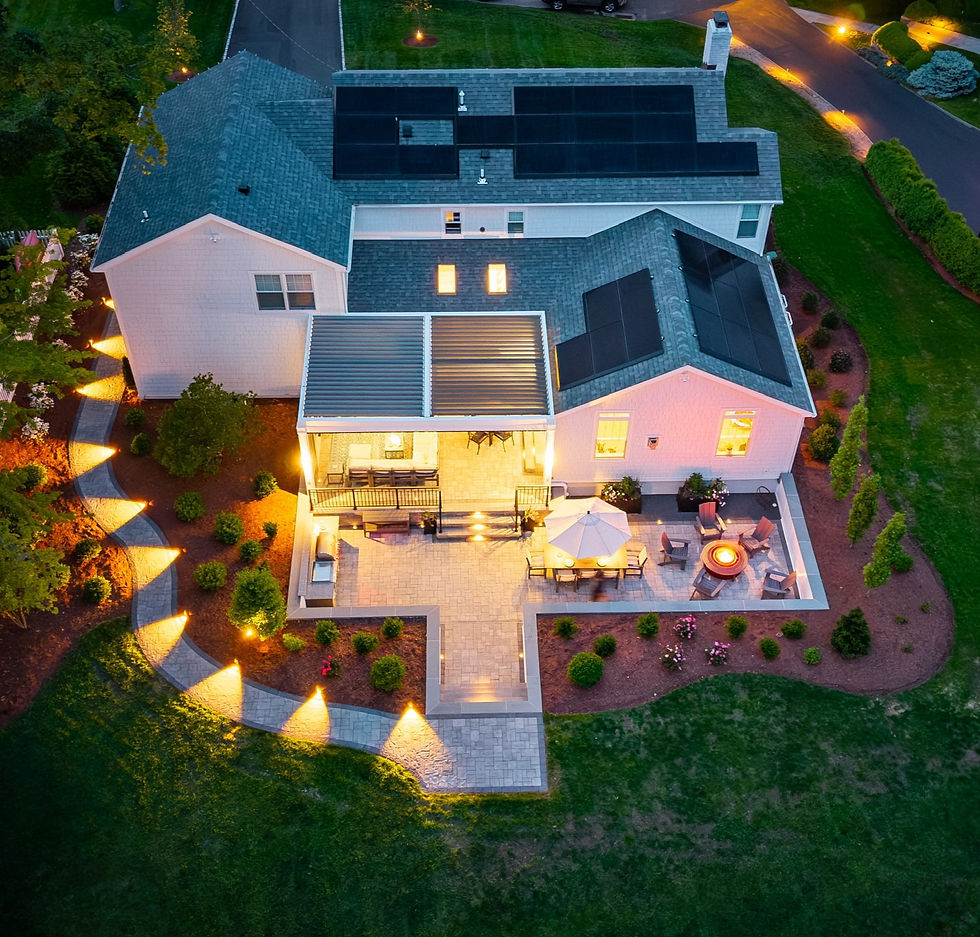
Exterior and Landscape Lighting

Fireplaces and Fire Features

Water Features and Waterfalls

Stone Veneer and Composite Stone Veneer

Outdoor Kitchens

Concrete

Deck Construction

Trails and Garden Paths

Driveways

Retaining Walls

3-Season and Enclosed Outdoor Living Spaces

Site Drainage & Water Management
Softscape Design & Planting Installation
Outdoor Living Design and Build

Double-Sided Stone Walls and Stone Columns

Fencing and Privacy Plantings
Commercial Retaining Walls-- ADD INTO RETAINING WALL SECTION


