%20(2).png)
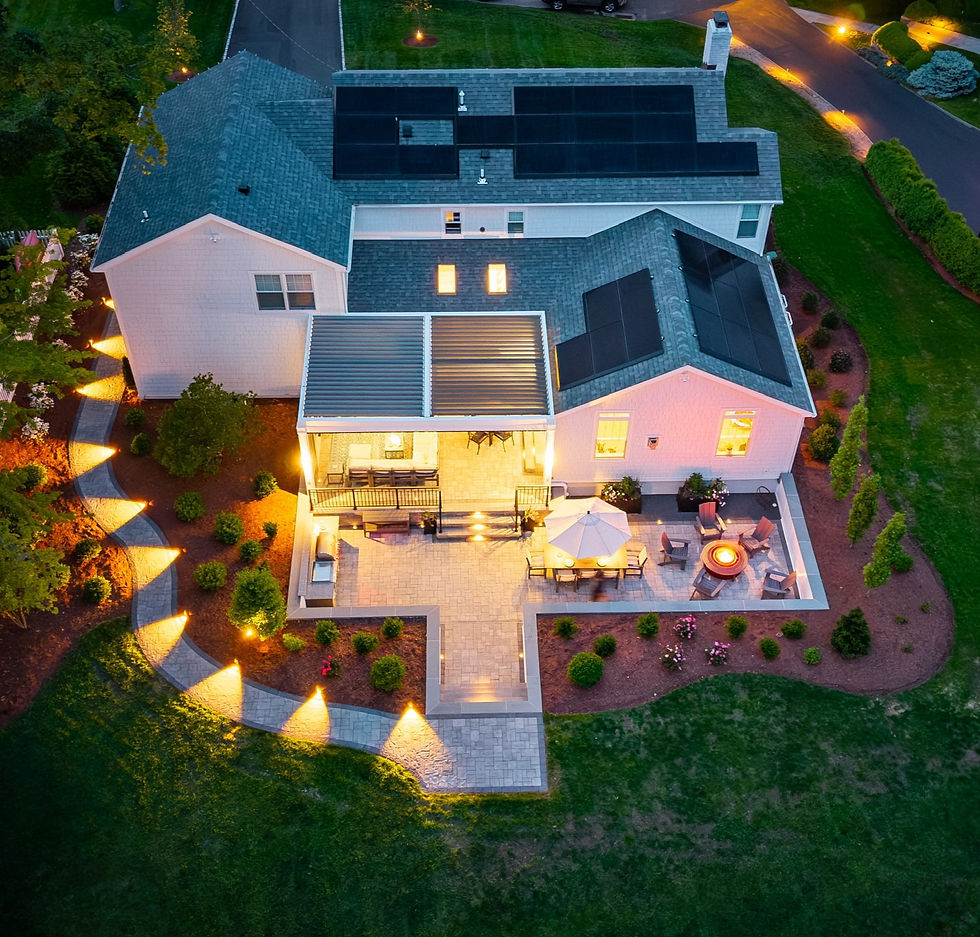
Custom Low-Voltage Landscape Lighting
We design and install low-voltage exterior, marine and landscape lighting as a permanent piece of property infrastructure. Our work completely eliminates consumer-grade components and seasonal solar novelties in favor of hardwired, micro-zoned systems that elevate architectural profiles, maximize property security, and expand usable outdoor living footprints well past sunset. Every project is designed from the ground up— with visualization, calculating precise voltage drop, load distributions, and lumen output—using non-corrosive raw metals that safely navigate harsh New England winters and maintain absolute structural permanence.


Local Information
Illuminating properties in rural, high-elevation corridors like Goshen, Bethlehem, and Litchfield requires a design approach that respects strict local dark-sky environmental ethics and sparse municipal street lighting. Fixture placement must prioritize glare-free down-lighting, path-focused shielding, and low-lumen architectural washes to avoid disruptive light pollution while securing estate perimeters. Geologically, the sloped, heavily wooded topographies of Washington, Roxbury, and Woodbury introduce significant grading and structural challenges. In these zones, lighting systems act as a critical safety mechanism, demanding heavy-bezel well lights to outline shifting terrain and flush-mount step risers to safely guide movement across sprawling natural stone terraces, cliff-edge grade changes, and winding timber trail networks.
For the large-scale equestrian properties and rolling agricultural acreage defining Newtown, Ridgefield, and Redding, the primary technical challenge is managing vast physical distances. Winding driveways, massive stone entry gates, and distant boundary stone walls require deploying thousands of linear feet of low-voltage cable. To execute these long-distance trunk lines without suffering voltage drop, we design split-load circuits utilizing heavy-gauge copper lines and balanced hub configurations. This ensures that a fixture positioned 400 feet away at a paddock gate receives the exact same electrical stability and illuminates with the precise color matching as a light positioned directly against the home’s foundation. For more dense areas like New Canaan and Westport, we proritize architectural enhancement and clean utility planning for the tighter, more restrictive lot sizes.
In formal suburban estate communities such as West Hartford, Avon, and Simsbury, properties feature tighter lot perimeters and distinct architectural styles, including classic Brick Georgians and detailed Colonial Revivals. Lighting design here demands absolute optical precision to completely eliminate light trespass onto neighboring properties. We utilize directional shrouds, internal hex-louvers, and ultra-narrow beam angles to isolate light throw strictly to the intended target. The focus centers on accentuating symmetrical masonry work, formal bluestone entryways, and manicured boundary hedges, adding dramatic visual depth that makes close-quarters backyard spaces feel secure, private, and vastly more expansive after dark.
Properties positioned along the Long Island Sound waterfront like Madison, Stonington, Fairfield and those alike-- face continuous, destructive environmental pressures, including high-salinity salt spray, dense brackish humidity, and extreme wind shear during coastal storms. Standard outdoor fixtures quickly pit, oxidize, and suffer total electrical failure in these conditions. Our coastal installation standard enforces a strict metallurgy policy: we completely ban powder-coated aluminum, utilizing only raw, solid sand-cast brass, thick copper, or marine-grade 316 stainless steel housings. Combined with IP67 or IP68 waterproof ingress ratings, these components withstand direct salt air exposure and driving shoreline rain without suffering structural or internal board corrosion.
General Design Information
Design Info (General)
High-end landscape lighting is entirely about the effect, not the source; the goal is to see the illumination, not the lightbulb. We utilize specialized design techniques to create deep visual layers and accent structural focal points across an estate:
Architectural Grazing: Placing fixtures tight to stone veneer walls or heavy stone chimneys, shooting light upward at a narrow angle to accentuate the natural texture, shadows, and crisp tool work of the masonry.
Silhouetting & Uplighting: Positioning fixtures at the base of mature hardwood trees or specimen evergreens, projecting light upward through the branch structure to define structural silhouettes against the dark night sky.
Moonlighting: Mounting low-profile, wide-angle fixtures high up in the interior canopies of mature oaks or maples, casting a soft, filtered down-light through the foliage to mimic natural moonlight across lawns, patios, and driveways.
Mirroring: Angling low-lumen fixtures to cast light onto water features or pool surrounds from a precise orientation, causing the illumination to reflect perfectly off the still water surface rather than cutting through it.
Our design process begins with a comprehensive site assessment. We don't just position lights randomly; we analyze key sightlines from inside the main living rooms of the home looking out. This ensures that your winter views do not look like a stark, black pane of glass, but instead draw the eye out to illuminated focal points. We strictly manage beam spreads—utilizing tight 15-degree spot optics for narrow stone pillars and wide 60-degree flood lenses for broad tree canopies. We maintain color temperature discipline, applying warm 2700K illumination across natural stone, timber, and softscape foliage to look organic, reserving crisper 3000K tones only for modern porcelain or highly contemporary architectural lines.
The Structure and Site
A low-voltage architectural lighting system must be built to survive the physical realities of shifting New England weather patterns. In Connecticut, the primary threats to system longevity are subsurface moisture tracking, cyclical frost lines, and routine landscape maintenance tools. If system components are treated as simple plug-and-play accessories, wire runs split, fixtures heave out of alignment, and connections fail within a single winter. Our installation approach focuses on protecting your investment by burying heavy-gauge lines deeply, using structurally stable solid brass fixtures, and deploying watertight moisture barriers that keep the electrical network completely isolated from the elements.
Heavy-Gauge Direct-Burial Wire: We use thick 12-gauge or 10-gauge multi-strand UF (Underground Feeder) copper cabling. We completely avoid thin 14- or 16-gauge lines that suffer rapid voltage drop and are easily severed by standard landscaping tools.
Trenching Depths: All primary power lines are trenched cleanly to deep, stable subgrade levels beneath turf areas and mulch beds. This insulates the cables from seasonal lawn aeration, mechanical spade edging, and frost heaving.
Watertight Gel-Filled Splice Connections: Every wire connection point is locked inside silicone-filled, waterproof wire nuts or heavy-duty mechanical splice enclosures. This prevents capillary water draw from wicking moisture up into the copper strands, eliminating internal wire corrosion and system short-circuits.
Professional-Grade Multi-Tap Transformers: System power is driven by heavy-duty, stainless steel magnetic transformers that plug directly into standard, code-compliant outdoor 120V GFCI outlets. Multiple voltage terminals ranging from 12V up to 15V allow our teams to balance the power across long runs, completely eliminating voltage drop and ensuring uniform light output across the entire property.
Core-Drilled Masonry Integration: For permanent stone features, patio perimeters, and steps, we core-drill fixtures directly into the granite, bluestone, or fieldstone layers. This hides all wiring paths within the masonry core and completely protects the fixtures from being struck by lawnmowers, foot traffic, or snowplows.
Before a single wire run is trenched, we conduct a thorough site audit of the property’s existing electrical infrastructure. We calculate the current load on your residential external GFCI circuits to verify available amperage and determine the optimal mounting locations for our stainless steel transformers. On the ground, we map out hidden subsurface infrastructure, tracing active irrigation zones, French drain networks, and buried secondary utilities. Mapping these zones beforehand allows us to plot clean trench paths that do not disrupt established root systems of specimen plantings or slice through hidden drainage lines, keeping your primary landscape infrastructure fully intact.
Popular Material Selections & Finishes
Choosing an exterior lighting finish requires balancing the property’s overarching architectural style with the physical reality of the ground environment. Fixtures placed at grade level are continuously subjected to moisture, lawn care equipment, dog urine, and corrosive organic mulch acids.
Landscape Lighting
Popular Materials: Solid Cast Brass, Heavy-Gauge Raw Copper, Aircraft-Grade Anodized Aluminum, Low-Voltage Integrated LED Modules (2700K–3000K), Multi-Tap Transformers (12V–15V).
Common Applications & Technical Info: Engineered for structural facade highlighting, safe pathway illumination, security boundary mapping, and hardscape accentuation (including under-cap wall lights and flush step inserts). Systems operate on low-voltage (12V–15V) alternating current routed through direct-burial landscape wiring (typically 12/2 or 10/2 AWG). Precision voltage drop calculations are mandatory for long runs to prevent dimming or uneven lumen output at the end of a zone line. To withstand high soil acidity, heavy New England rainfall, and seasonal freeze-thaw cycles, all subterranean wire joints must utilize moisture-proof, silicone-filled mechanical splices or heat-shrink tubing to stop ground faults and capillary water wicking into the copper leads.
Aesthetics & Maintenance: Focuses on seamless visual design utilizing specific color temperatures: 2700K warm-white is preferred to enhance the rich earth tones of natural New England masonry and foliage, while 3000K provides a crisper look for contemporary architectures or silver-toned stone flatwork. Heavy cast brass and copper alloys are specified because they naturally oxidize into a deep structural bronze or verdigris patina, completely eliminating the chipping, bubbling, and corrosion issues common to painted metals. Maintenance requires seasonal pruning of surrounding plant growth, clearing mulch off lens housings to maintain proper thermal dispersion, and checking fixture alignments after winter frost heaving.
Pricing Guidance: Professional-grade solid cast brass and copper low-voltage LED systems represent a premium architectural investment. They deliver an indefinite operational lifespan and a fractional energy footprint, easily outperforming cheap aluminum or retail-grade composite alternatives.

Dock Lighting and Marine Lighting
Popular Materials: Solid Cast Brass, 316 Marine-Grade Stainless Steel, Heavy-Gauge Copper, Low-Voltage LED Modules.
Common Applications & Technical Info: Specialized illumination systems engineered for installation on coastal docks, lakefront bulkheads, seawalls, and marine boardwalks across Connecticut's shorelines and inland waterways. Fixtures must possess a minimum IP67 or IP68 ingress protection rating to withstand direct wave wash, tidal submersion, and constant airborne salt mist. Systems operate on safe, low-voltage (12V-15V) currents supplied by multi-tap transformers with integrated surge protection.
Aesthetics & Maintenance: Raw copper and solid brass fixtures slowly develop an architectural verdigris or deep bronze patina that integrates seamlessly into marine settings, completely resisting the peeling and bubbling common to painted alloys. Maintenance requires wiping optical lenses clear of salt crusts and algae growth, alongside checking waterproof heat-shrink wire connections annually.
Pricing Guidance: A highly specialized, top-tier premium asset category engineered strictly for extreme environmental resilience and waterfront safety compliance.
Additional Features / Related Services
Core-Drilled Masonry Step & Wall Lights: Recessed LED fixtures flush-mounted directly into stone steps or underneath retaining wall caps for clean, seamless path illumination.
Smart Zone-Control Automation: Integrating transformers with smart control systems (like Lutron or FX Luminaire) to allow zoning, dimming, and smartphone scheduling.
High-Canopy Moonlighting: Installing fixtures high up in mature hardwoods to cast natural, dappled light down onto large lawn expanses or driveways.
Submersible Pond & Water Feature Lighting: IP68-rated underwater brass fixtures to illuminate waterfalls and pool features safely from beneath the water's surface.
Regulatory Considerations for Custom Low-Voltage Landscape Lighting
All lighting installations are executed in strict compliance with National Electrical Code (NEC) Article 411, which governs low-voltage lighting systems. Transformers are mounted securely and plugged into code-compliant, weather-shielded outdoor GFCI outlets featuring "while-in-use" covers. In accordance with NEC Article 680 restrictions for water safety, fixtures installed near swimming pools or custom water features maintain a mandatory safe setback distance of at least 10 feet from the water’s edge unless specifically engineered, low-voltage encapsulated, and listed for closer proximity. We also cross-reference all layout profiles with local town zoning dark-sky ordinances to ensure property perimeters remain compliant regarding maximum fixture lumen outputs and mandatory downward shielding.
Common Installation Failures
Pierce-Point Squeeze Connectors: Cheap plastic squeeze connectors puncture wire insulation to make a contact. Over one New England winter, water seeps into these punctures, corroding the line from the inside out. We never use them; every single splice must be a fully sealed, gel-filled connection.
Severe Voltage Drop: When too many lights are placed on a single thin wire loop, the fixtures at the end of the line turn a dim, sickly yellow. We prevent this by engineering balanced T-method wire loops and matching output loads to multi-tap transformer terminals.
Shallow Wire Laying: Wires lazily tucked just an inch under the mulch will inevitably be sliced by a landscaping crew during spring cleanups. Lines must be trenched cleanly to deep, stable subgrade levels.
Blinding Fixture Glare: Poorly aimed well lights or unshielded path fixtures can shine directly into people's eyes as they walk up steps or patios. We eliminate this by utilizing directional glare shields, drop-prism lenses, and recessed optics.